The Anti-Playbook: Build the Learning Loop Before You Build the Machine
A demand generation operating model for deciding what deserves to become repeatable.
Early stage demand generation often gets built in the wrong order.
Teams clean the CRM, finalize the ICP, rebuild nurture, fix attribution, produce content, create scoring models, and stand up dashboards — then finally put the strategy in front of the market.
None of that work is inherently wrong.
The sequencing often is.
The Anti-Playbook starts with a different question:
What is the smallest safe motion we can put into the market now, while the rest of the system catches up?
The goal is not to move recklessly fast. It is to shorten the distance between hypothesis → market contact → evidence → decision → next test — and to build more infrastructure only when the evidence justifies it.
The Problem With the Usual Sequence
A traditional early-stage demand generation plan often looks something like this:
Research → Messaging → Infrastructure → Content → Campaigns → Pipeline
The logic is reasonable. But when every step becomes a prerequisite for market contact, three things happen:
Learning arrives late
The team spends weeks refining assumptions before real buyer behavior has a chance to challenge them.
Infrastructure feels like progress
A cleaner CRM or more sophisticated workflow can create visible activity without proving the underlying motion deserves to exist.
Scale gets designed too early
Automation, content, routing, and reporting get built around logic that may still be wrong.
The Anti-Playbook does not reject research, systems, content, or measurement.
It changes when they earn the right to become more elaborate.
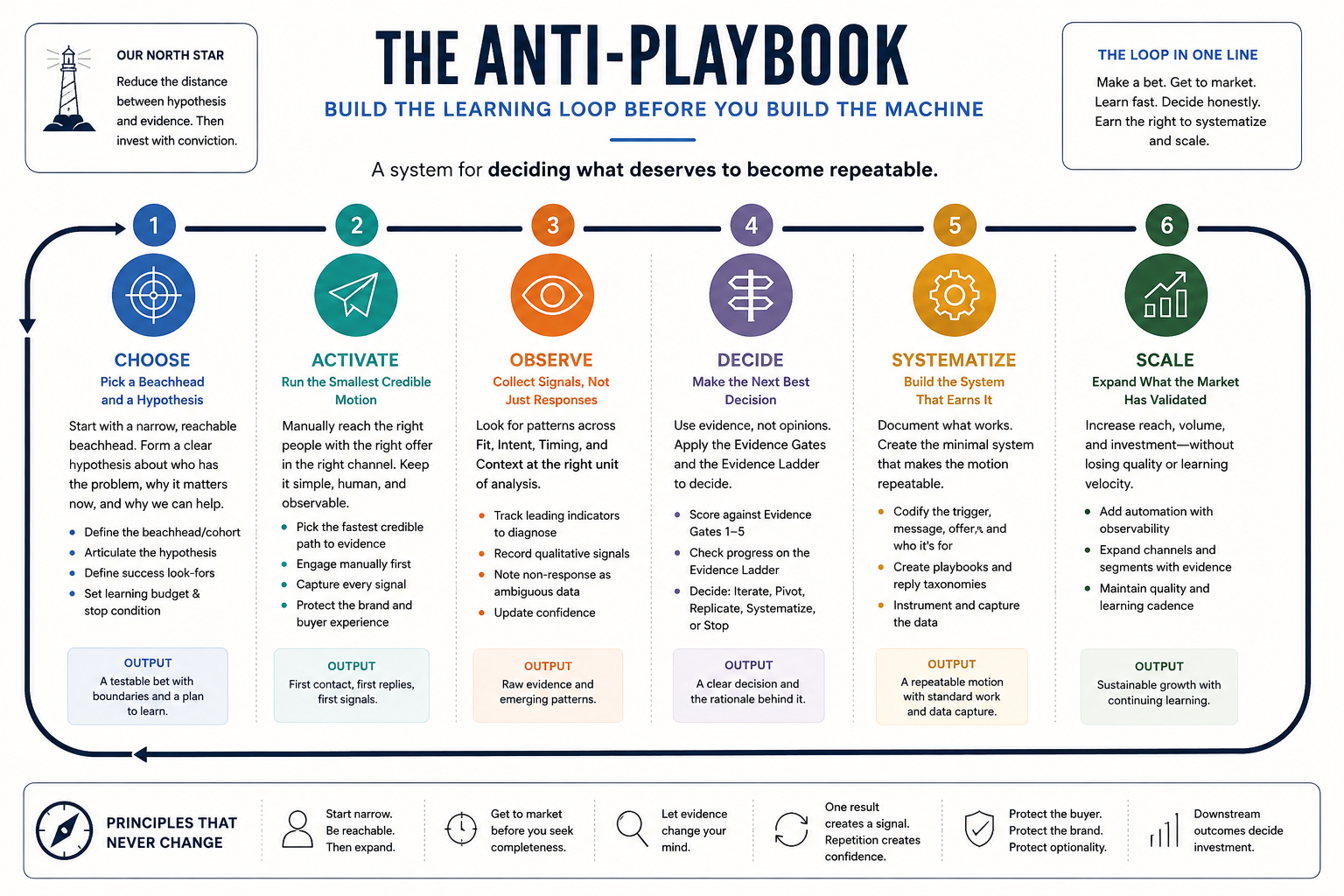
The Operating Loop
The model is deliberately simple:
Choose
Make a narrow hypothesis about who, what problem, why now, what offer, and which motion.
Activate
Put the hypothesis in front of real buyers using the lowest-complexity credible motion.
Observe
Capture behavior, objections, timing, non-fit patterns, and buyer context.
Decide
Continue, revise, stop, change channel, or expand the test.
Systematize
Build the repeatable operating layer around logic that has earned investment.
Scale
Add volume, automation, spend, segments, channels, or capacity only after repeatability appears.
Scale is not the end of the loop. More volume creates new evidence. The system should keep learning rather than turning yesterday’s assumptions into permanent infrastructure.
The point is not to prove the first idea right. It is to create an operating rhythm where the company can change its mind before it scales the wrong thing.
Explore the full operating model →
Three Ideas That Change How the Model Works
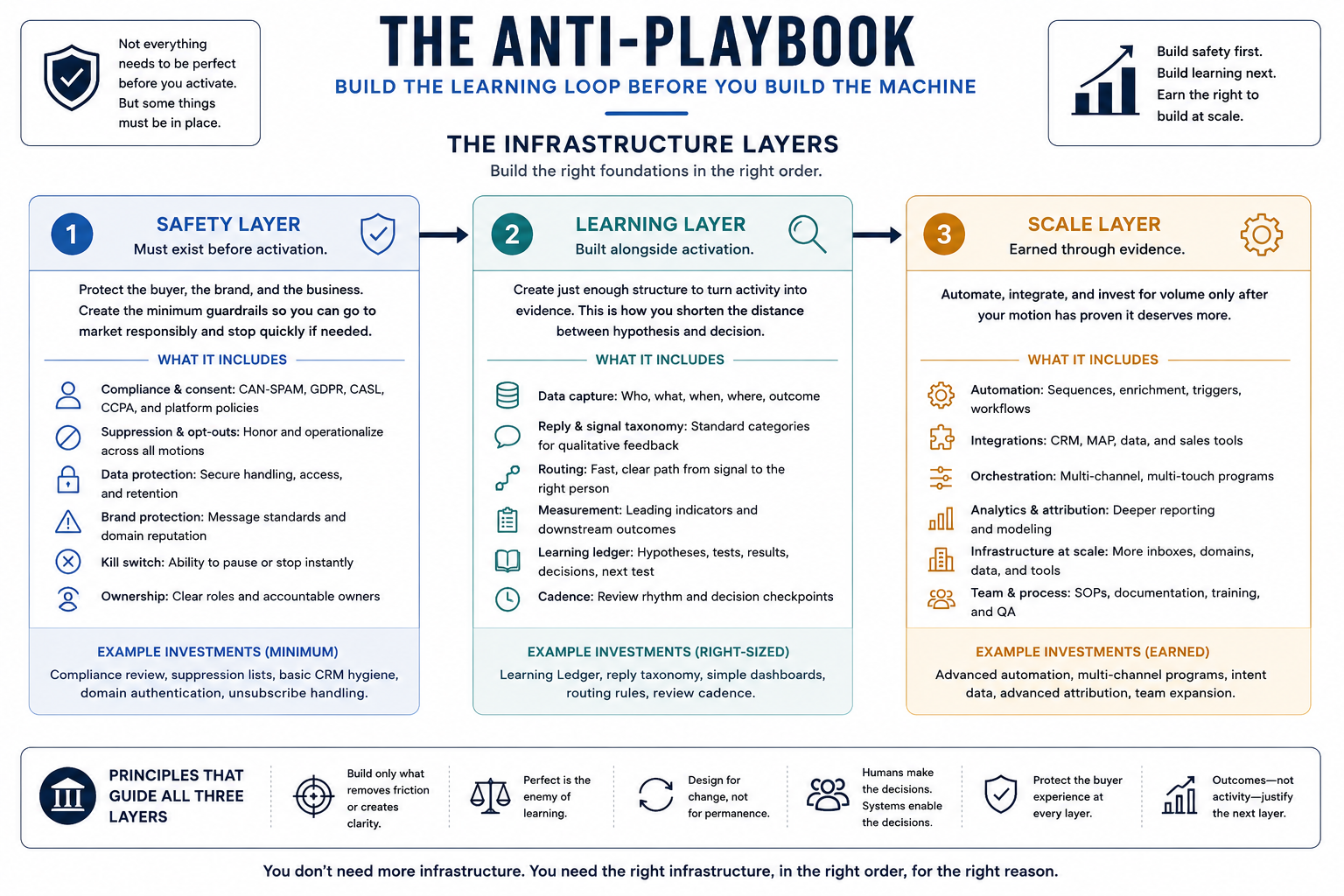
1. Not all infrastructure belongs on the same stage
The Anti-Playbook separates infrastructure into three layers:
Saftey
Must exist before activation
Examples: consent, suppression, ownership, minimum data capture, legal and brand guardrails, stop capability
Learning
Built alongside activation
Examples: exposure, outcomes, buyer context, Sales response, decision capture, next-test logic
Scale
Earned through evidence
Examples: automation, enrichment, orchestration, advanced routing, integrations, sophisticated reporting
The Anti-Playbook is not anti-infrastructure. It is against building scale infrastructure before the motion has earned scale.
2. Scale is an evidence decision, not a calendar milestone
A 30/60/90-day plan can help communicate work. It should not decide whether a motion is ready for more investment.
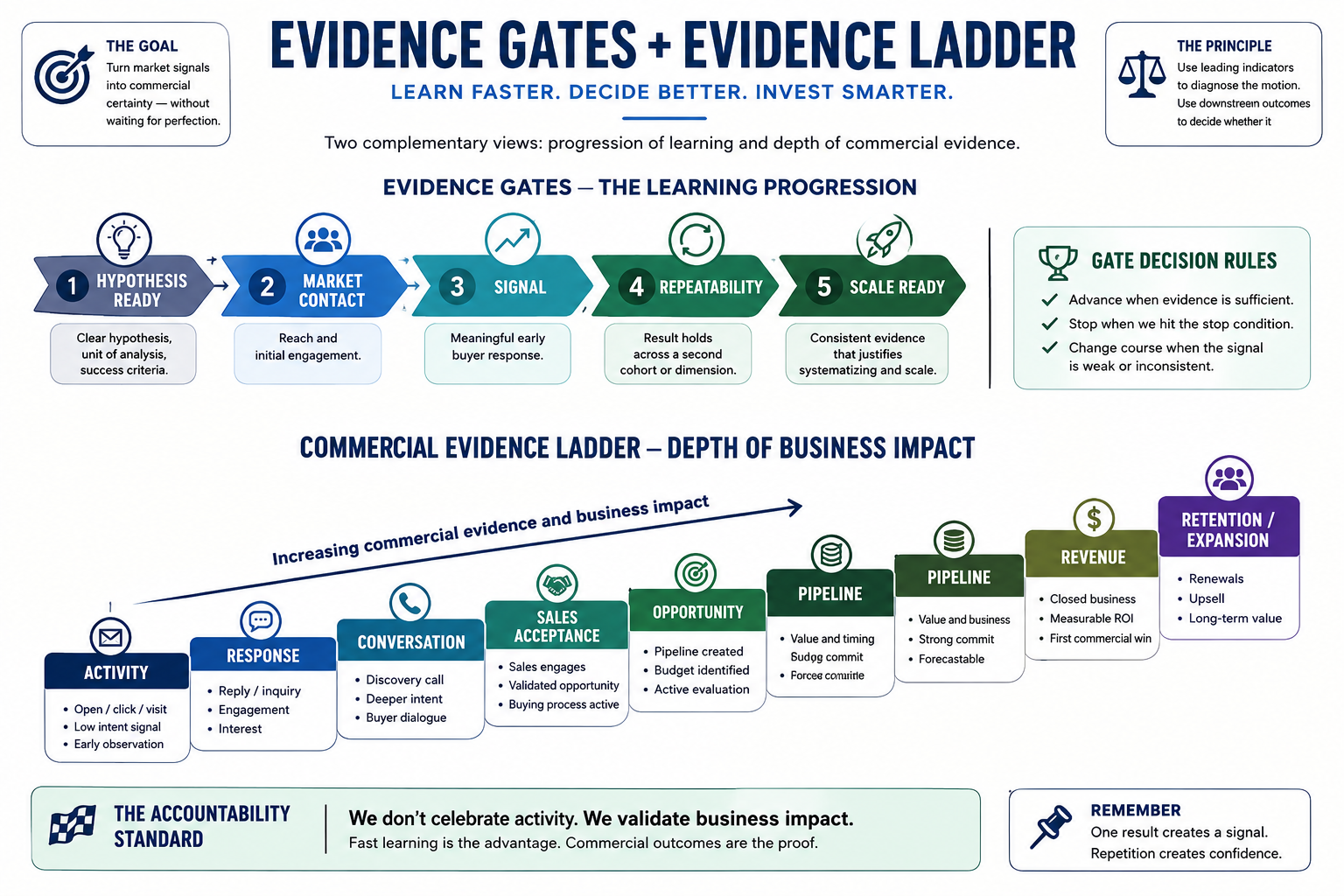
The framework uses five Evidence Gates:
Hypothesis Ready → Market Contact → Signal → Repeatability → Scale Ready
Then it asks a separate question through the Evidence Ladder:
Activity → Response → Conversation → Sales Acceptance → Opportunity → Pipeline → Revenue → Retention/Expansion
Those are not the same axis.
The gates ask: How confident are we that this motion deserves to progress?
The ladder asks: How far has the evidence traveled toward business impact?
That distinction keeps “we learned a lot” from becoming a permanent excuse for weak commercial outcomes.
Use leading indicators to diagnose the motion. Use downstream outcomes to decide whether it deserves more investment.
3. One result is not a system
Small B2B samples create a constant temptation to turn a promising result into an operating model too quickly.
The Anti-Playbook uses a simple replication rule:
One result creates a signal. Repetition creates confidence.
Replication does not require a massive experiment. It can mean another cohort, another seller, another time period, another message, another geography, or another comparable audience.
The point is to establish enough confidence that you are scaling a pattern rather than an anecdote.
Where AI and Automation Fit
This framework is not anti-automation either.
Automation is valuable when it removes the cost of repeating logic that has earned enough confidence.
It becomes dangerous when it makes weak logic harder to inspect and more expensive to unwind.
The practical guardrail is:
Do not automated a hypothesis beyond the point where humans can still inspect the logic, detect failure, and change course cheaply.
AI can classify responses, summarize conversations, structure buyer signals, retrieve account context, generate controlled variations, recommend next actions, and reduce operational maintenance.
But access to the model is not the durable advantage.
The durable advantage is the buyer context the organization retains and the quality of the decisions it makes from that context.
AI is the activation layer. Buyer memory is the asset.
What the Full Framework Goes Deeper On
The complete Anti-Playbook is intentionally more detailed than this introduction.
It includes:
How to choose a beachhead hypothesis without pretending you already have a validated ICP
A six-part test for choosing the first motion based on reachability, feedback speed, signal quality, economics, execution fit, and strategic value
How to set different evidence horizons for fast-cycle versus compounding motions
Why market response should be triangulated with interviews, closed-won analysis, win/loss, Sales calls, CRM history, and behavioral data
The complete Evidence Gates with exit conditions, learning budgets, and stop conditions
The Evidence Ladder and how far different tests should reasonably travel before more investment is justified
The Replication Rule for small-sample B2B environments
A modern qualification model that separates Fit, Intent, Timing, Context, Action, and Latency
How to use a Demand Gen Learning Ledger so campaign learning becomes organizational memory
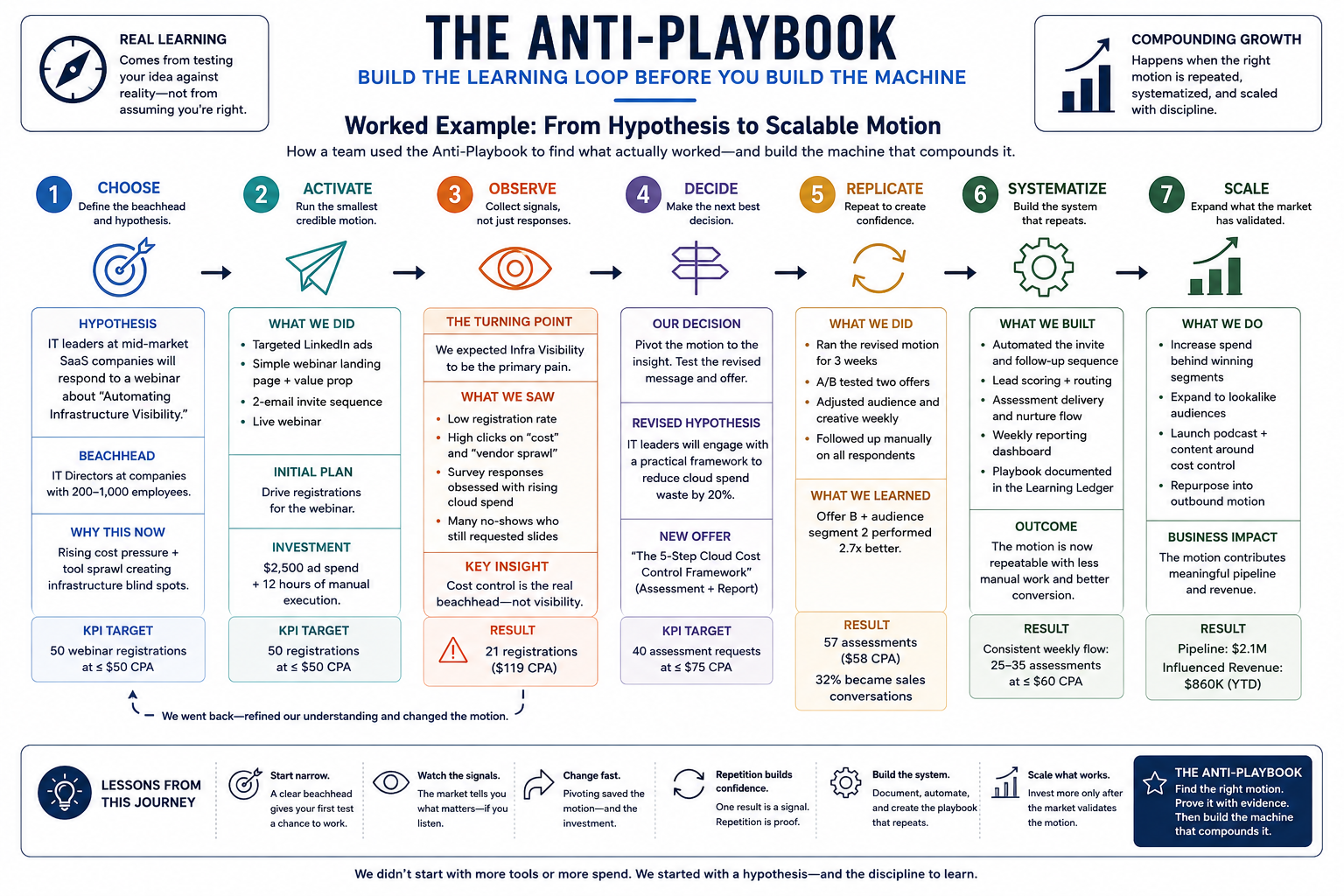
A full worked example showing the original hypothesis being partially disproven before the company systematizes and scales
The boundary conditions where the framework becomes less useful or the wrong tool entirely
Read the Full Anti-Playbook
The full framework is published in Notion as the canonical version — including the complete operating model, evidence architecture, qualification model, implementation guidance, worked example, and limitations.